Restaurant Finance · 2026-07-28 · 13 min
Should I Raise the Price or Reduce the Portion Size of a Low-Contribution Restaurant Dish?
Raise the price when the portion is already right for the dish and the new price still makes sense in the guest’s experience. Reduce the portion only when a smaller serving remains a complete, satisfying dish and the saving is supported by a current recipe, usable yield and invoice cost. If neither condition is true, do neither: investigate recipe design, waste, sales mix or the dish’s role instead.
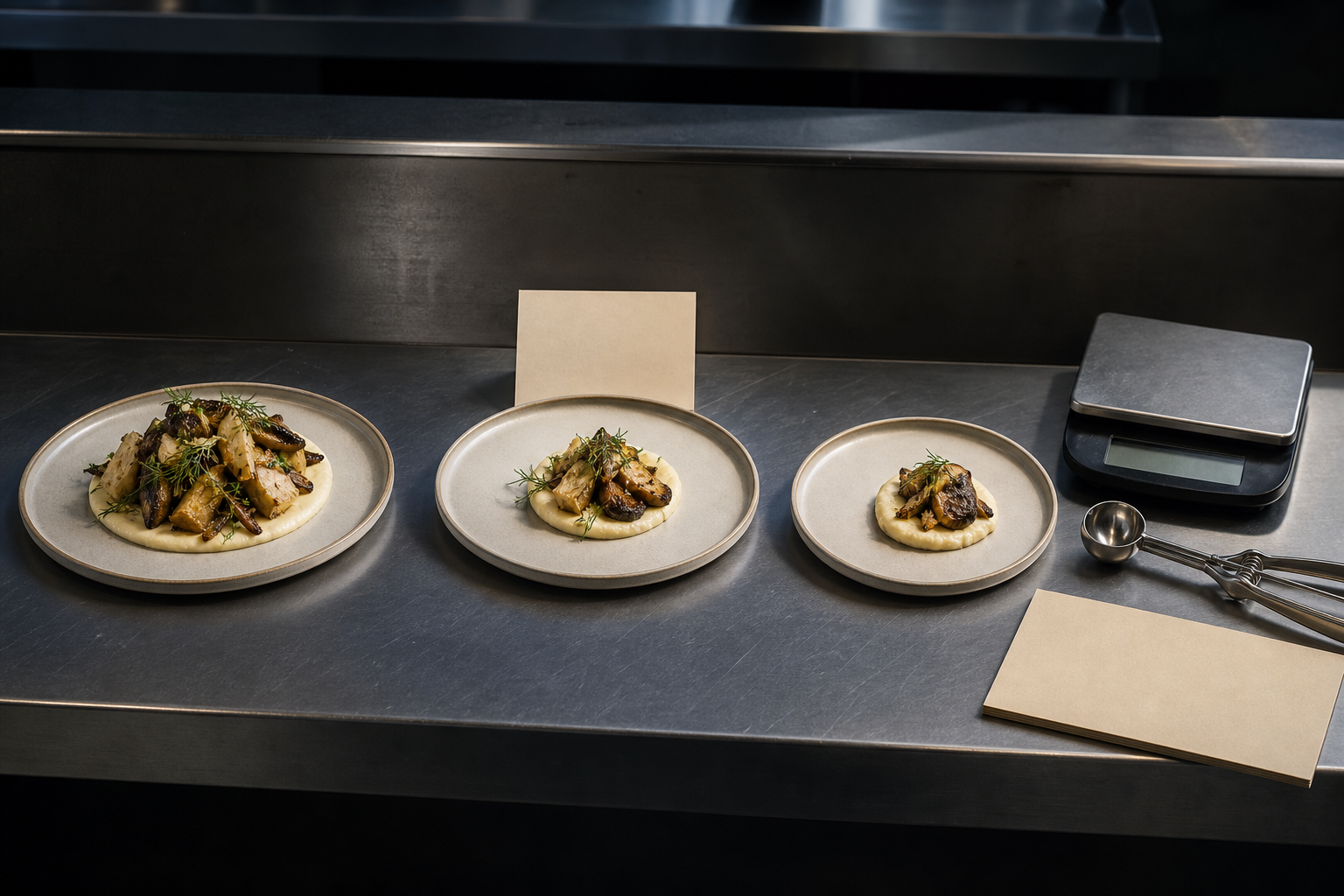
The PACE framework: Protect, Account, Compare, Experiment
Use PACE to keep this decision from collapsing into “charge more” versus “serve less.”
1. Protect the dish promise.
Write one sentence stating what must remain true after the change. It might cover the dish’s role, composition, visual balance, satiety, shareability, consistency or relevance to a particular guest need. This is a local operating standard, not a universal portion target.
Then set non-negotiable gates:
A portion reduction that fails these gates is not a margin option. A price increase can also fail if it makes the dish difficult to explain or creates an awkward menu relationship.
2. Account for the current dish.
Use the same measurement period and the same cost basis for all three cases. For the current dish, record:
For this decision, calculate:
contribution per sale = selling price − variable ingredient cost per sale
weekly contribution = contribution per sale × weekly units sold
This deliberately isolates the item-level comparison. It does not turn contribution into net profit. Labour, tax, fixed costs and other operating effects still require separate review.
3. Compare three cases, not two.
“No change” is an active control. Without it, both interventions can look attractive simply because their assumptions were optimistic.
Copy this worksheet and replace every assumption with local data:
| Field | Current dish | Price-change case | Portion-change case |
|---|---|---|---|
| Ingredient cost per sale | ___ | Usually unchanged unless the recipe changes: ___ | Re-costed recipe using usable yield: ___ |
| Selling price | ___ | Proposed price: ___ | Usually unchanged unless testing a combined change: ___ |
| Contribution per sale | Price − cost: ___ | Price − cost: ___ | Price − cost: ___ |
| Expected weekly units | Observed baseline: ___ | Assumption: ___ | Assumption: ___ |
| Weekly contribution | Contribution × units: ___ | Contribution × units: ___ | Contribution × units: ___ |
| Break-even weekly units versus current | Not applicable | Current weekly contribution ÷ revised contribution per sale: ___ | Current weekly contribution ÷ revised contribution per sale: ___ |
| Evidence still missing | ___ | Sales response, value response: ___ | Yield, execution, plate and value response: ___ |
| Gate result | Baseline | Pass / fail | Pass / fail |
Round a break-even result up to the next whole serving. If the price case needs 73.2 sales to preserve current weekly contribution, the operational threshold is 74 sales—not 73.
The expected-units row is an assumption until observed. Do not quietly carry current sales into both cases as though neither guests nor operations will respond.
4. Experiment with one reversible change.
Select only a case that improves the model and passes its gates. Define the test before launch: one dish, one intervention, a start and end, equivalent comparison periods where practical, a named owner and a review date. Keep the recipe, menu, point-of-sale record and staff briefing aligned so the measurement describes what was actually served.
Do not change price and portion simultaneously if the purpose is to learn which intervention worked. A combined change may be operationally necessary, but it cannot isolate the effect of either lever.
- The finished plate still meets the approved recipe and presentation standard.
- Any altered serving can be produced consistently with the available tools and station setup.
- Ingredient, allergen and nutrition information is reviewed wherever the change affects it.
- The value proposition remains intelligible alongside comparable items on your own menu.
- Managers know what guest and service signals to record during the test.
- ingredient cost per sale, from the current standardized recipe, invoice cost and usable yield;
- selling price;
- units sold in a representative week;
- contribution per sale; and
- weekly contribution.
Decision table: which intervention deserves a pilot?
| Situation | Price pilot | Portion pilot | No-change / investigate |
|---|---|---|---|
| Portion is already central to the dish’s promise | Candidate if value and menu relationships pass | Reject | Use if price also fails |
| A smaller portion improves balance without making the plate feel incomplete | Possible, but not the first inference | Candidate after recipe and plate checks | Use if savings are too uncertain |
| Recipe quantity, yield or invoice unit is uncertain | Model only; first fix the cost basis | Reject until re-costed | Preferred next action |
| Proposed price preserves a coherent value story on your menu | Candidate | Consider independently | — |
| Staff cannot execute the smaller standard consistently | — | Reject | Fix portion tools or recipe control first |
| Both cases model below current weekly contribution | Reject | Reject | Diagnose waste, recipe, mix or menu role |
| Both model above current weekly contribution | Choose the one with the stronger evidence and lower service risk | Choose the one with the stronger evidence and lower service risk | Keep as control during testing |
| Dish supports a strategic guest need not captured by item contribution | Do not decide on arithmetic alone | Do not decide on arithmetic alone | Review its wider menu role |
The table does not crown price or portion as universally safer. It makes the burden of proof different: a price case mainly needs a credible demand and value test; a portion case needs those checks plus a verified recipe-cost change and repeatable execution.
Example: a localized three-case comparison using an index
The following is an arithmetic illustration, not a market price, restaurant result or recommended change. To avoid implying that one currency or local price level fits every market, the current selling price is normalized to a 100-point selling-price index. Replace the indexed values with your own currency amounts before making a decision.
Assume the baseline worksheet contains:
Now work each case:
| Measure | Current dish | Price-change case | Portion-change case |
|---|---|---|---|
| Selling-price index | 100 | 106 | 100 |
| Ingredient-cost index | 35 | 35 | 31 |
| Contribution per sale, index points | 65 | 71 | 69 |
| Weekly units | 80 observed | 74 assumed | 77 assumed |
| Weekly contribution index | 5,200 | 5,254 | 5,313 |
| Whole-unit break-even versus current | — | 74 | 76 |
For the price case, 5,200 ÷ 71 = 73.24, so it needs at least 74 whole sales to match the baseline. At the assumed 74 sales, its indexed weekly contribution is 5,254.
For the portion case, 5,200 ÷ 69 = 75.36, so it needs at least 76 whole sales. At the assumed 77 sales, its indexed weekly contribution is 5,313.
The portion case is higher in this model, but that is not a recommendation. Its apparent advantage depends on two unproven inputs: that the revised recipe really reduces cost from 35 to 31 index points, and that the dish can still sell 77 times while passing every quality and value gate. The price case has less indexed contribution at its assumed volume, but it may protect the established plate. The correct next step is to challenge the weakest assumption, reject any case that fails a gate, and pilot one viable change against the no-change baseline.
- current selling-price index: 100;
- current ingredient-cost index: 35;
- observed baseline sales: 80 servings;
- price-case selling-price index: 106;
- price-case expected sales assumption: 74 servings;
- portion-case ingredient-cost index: 31, based in a real decision on a re-costed recipe rather than a guessed saving;
- portion-case expected sales assumption: 77 servings; and
- unchanged portion-case selling-price index: 100.
How to implement the comparison in service
1. Freeze the baseline. Record the current recipe version, portion tool, invoice units, usable-yield assumption, selling price and units sold for the selected period. 2. Re-cost the portion case physically. Build the proposed plate, weigh or measure the changed components, apply current usable cost and confirm that garnish, sauce, sides and waste have not been overlooked. 3. Write the price case plainly. Record the proposed price and the minimum whole-unit sales threshold. Identify what evidence would make the expected sales assumption credible in your own operation. 4. Apply the six gates. Mark pass or fail for plate quality, guest value, recipe standard, usable yield, service execution and a time-bounded review. A blank is not a pass. 5. Model all three cases. The free RestaurantMargin workspace accepts ingredient cost, selling price and weekly sales and displays contribution margin and weekly contribution. Its five-dish limit is enough to enter the current dish and two revised versions as separate items. Do not treat those entries as saved scenarios; saved scenarios are listed as a Pro feature. 6. Choose one test. Prefer the case supported by the stronger inputs and fewer unresolved operating risks, not merely the larger projected number. 7. Brief the team. State exactly what changes, what stays fixed, which recipe or price is live, and who records exceptions, returns and execution problems. 8. Review against the pre-written rule. Compare observed units and weekly contribution with the baseline and break-even threshold. Review the quality and value gates alongside the arithmetic. 9. Keep, revise or reverse. Document the decision. If the result is ambiguous, do not present it as a win; restore the baseline or run a better-controlled follow-up.
A pre-service pass/fail checklist
Before approving either intervention, answer every line:
Any failed safety, recipe or guest-promise gate stops the portion case. Any unsupported demand assumption weakens the price case. Missing evidence is a reason to measure, not a reason to choose the more comfortable story.
- [ ] Baseline ingredient cost uses the current recipe, invoice unit and usable yield.
- [ ] Baseline units come from a defined, comparable period.
- [ ] Price-case break-even units are calculated and rounded up.
- [ ] Portion-case savings come from the revised recipe, not a blanket percentage.
- [ ] The finished portion passes a plate-quality review.
- [ ] The change preserves a coherent value proposition on this menu.
- [ ] The recipe and portion tool can be followed consistently in service.
- [ ] Relevant allergen or nutrition controls have been reviewed locally.
- [ ] Only one intervention is changing if causal learning is the goal.
- [ ] Test owner, dates, evidence and reversal rule are written down.
- [ ] Weekly contribution is not being described as net profit.
Limitations and trade-offs
This framework is a decision aid, not a forecast. Expected weekly units for either revised case are assumptions until tested locally. A short test can also be distorted by day mix, availability, events, weather, promotions, competitor actions or unrelated service problems; choose comparison periods carefully and record exceptions.
Ingredient cost per sale depends on current recipe quantities, invoice units and usable yield. It can be wrong even when the arithmetic is correct. A smaller specified portion may not reduce actual usage if execution varies, prep loss rises or the removed ingredient is not the true cost driver.
Weekly contribution is not net profit. This worksheet does not by itself resolve labour changes, tax, fixed costs, payment costs, packaging, waste, cannibalisation, shared prep, capacity effects or the value of a dish within the wider menu. Add locally relevant variable costs when they differ between cases, and review period expenses separately.
Guest response is not fully represented by units sold. Returns, substitutions, verbal feedback, changed attachment purchases and repeat behaviour may matter, but this article supplies no universal measurement window or threshold. Set those rules from the operating context rather than borrowing an unsupported benchmark.
Finally, legal, nutrition and allergen obligations vary. A recipe or portion change should pass the restaurant’s applicable local controls before service.
FAQ
Is raising the price always safer than reducing the portion?
No. It preserves the physical dish but introduces an uncertain sales and value response. A portion reduction introduces that response as well as recipe, yield, execution and plate-quality risks. Compare both with no change and reject any option that fails its gates.
Should I choose the option with the lowest food-cost percentage?
No. Use contribution per sale and expected weekly contribution for this item-level comparison. A lower percentage does not establish more contribution, and more contribution does not establish higher net profit.
How do I calculate the maximum sales decline after a price increase?
First calculate current weekly contribution. Divide it by revised contribution per sale, then round up to the next whole serving. That is the minimum weekly unit count needed to match the baseline under the costs included in your model. Subtract it from baseline units to see the modeled unit cushion.
Can I reduce only the expensive component of the plate?
You can model that option, but it still needs a rebuilt recipe cost and a physical plate review. Consider composition, guest value, consistency, usable yield and service execution. Do not infer the saving from weight alone without the current usable cost.
What if both interventions fail?
Keep the baseline while investigating other causes or choices: recipe architecture, purchasing, yield, portion variance, waste, menu placement, sales mix, prep complexity or whether the dish should remain in its current role. “Neither” is a valid decision.
Can I test a higher price and a smaller portion together?
You can make a combined change, but you will not learn which lever produced the response. If the objective is a clean comparison, test one change at a time and retain the no-change case as the control.
Next step
Run your menu numbers before changing prices. Use the free calculator, then turn the best opportunities into a weekly margin routine.
Open the calculator