Restaurant Finance · 2026-09-21 · 6 min
Restaurant Yield Tests: Turn As-Purchased Weight Into True Plate Cost
A yield test measures what you actually get to cook from what you paid for. You weigh the product as purchased (AP), trim or fabricate it the way the line will, weigh the usable product (EP, or edible portion), and divide the invoice price by that usable weight. A strip loin invoiced at $9.40 per pound with a 77% yield costs $12.17 per usable pound, and every dish using it is under-costed by roughly 29% until someone fixes the recipe.
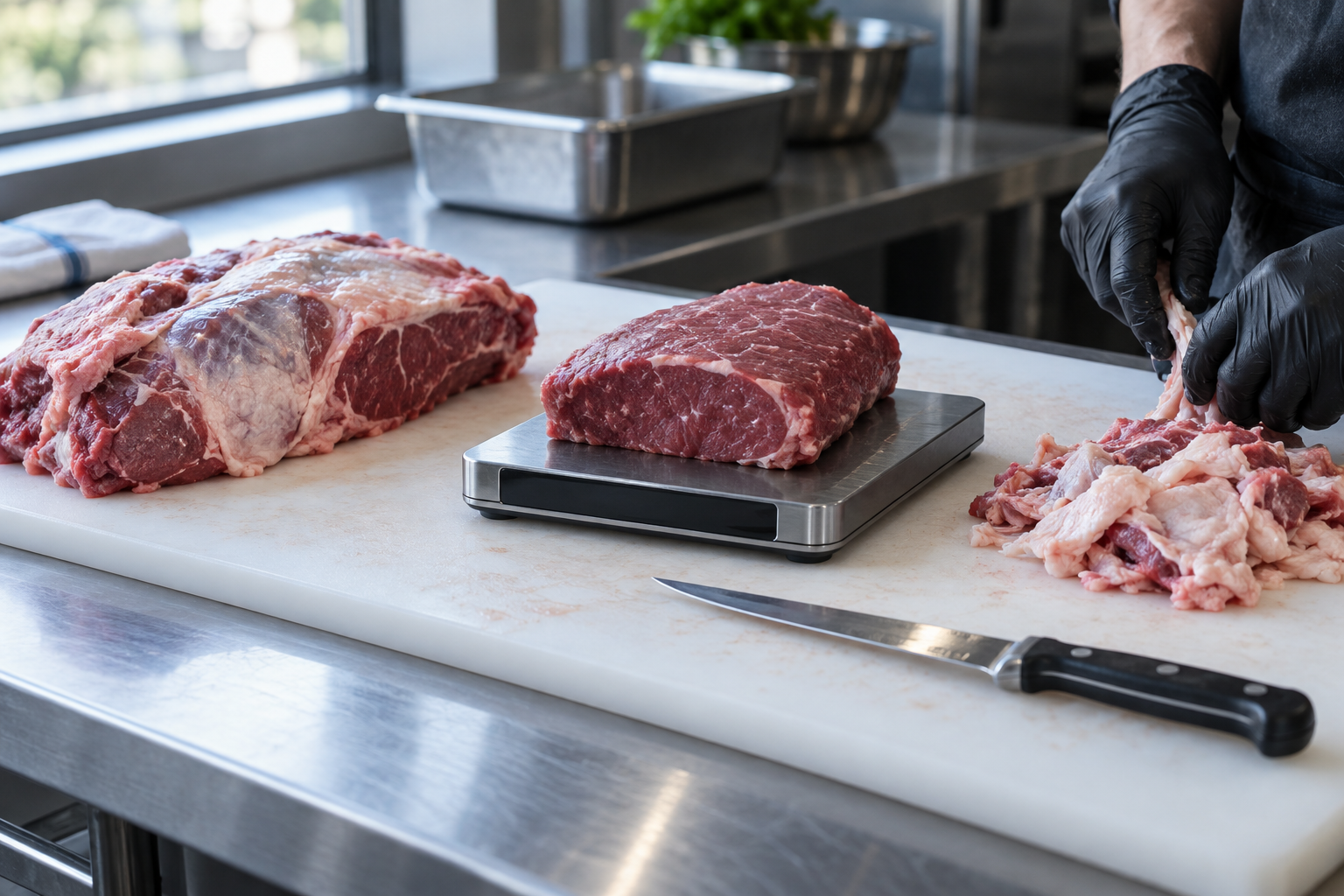
Why invoice price misleads
Most plate costs start from the invoice price per pound and stop there. That works for items you cook whole and sell whole, like a pork belly portion. It fails for anything you trim, portion, peel or bone out, because the price you paid covers parts you cannot sell: fat, silver skin, bone, peels, seeds and trim.
When yields are ignored, three things happen at once:
- Low-yield dishes look more profitable than they are.
- High-yield dishes look worse than they are, so you may avoid selling a dish that actually carries the menu.
- Menu price decisions and portion decisions are made on a cost number that cannot be reproduced on a busy Saturday.
The yield test procedure
Run the test once per item, on a normal delivery, with the person who actually fabricates it:
1. Weigh the product as purchased on a scale accurate to a tenth of a pound or to the gram, and record the invoice price per unit. 2. Fabricate it exactly as the kitchen does, at normal speed. Do not trim more carefully than service allows; that produces a yield nobody can hit. 3. Separate and weigh each output: usable product, trim you will reuse (stock, trim sales, staff), and true loss (fat, bone, inedible). 4. Repeat on three deliveries and average the results. Single-test yields bounce around with supplier trimming and season. 5. Record yield percentage and cost per usable unit in the recipe file, not in someone's notebook.
The math is short:
- Yield % = usable weight ÷ as-purchased weight × 100
- Cost per usable unit = as-purchased cost ÷ usable weight
Worked example: strip loin and a case of tomatoes
The numbers below are illustrative.
Strip loin. As purchased: 14.5 lb at $9.40/lb, so $136.30. After trimming: 11.2 lb usable, 2.1 lb trim, 1.2 lb loss.
A dish using an 8 oz portion therefore carries $6.09 of protein cost, not the $4.70 the invoice suggests — a difference of $1.39 per plate. At 40 plates a week that is $55.60 of contribution that was never in the recipe.
A case of tomatoes. As purchased: 25 lb for $28.00. After coring and dicing: 21.0 lb usable, 3.4 lb trim and 0.6 lb loss.
Whole fish. Same method, bigger stakes: a 12 lb fish that yields 6.2 lb of usable fillet costs nearly double the invoice price per pound, and the skeleton and head either become stock or are pure loss. If they become stock, credit the trim at what it would have cost to buy stock, and say so in the recipe note.
- Yield: 11.2 ÷ 14.5 = 77.2%
- Cost per usable pound: $136.30 ÷ 11.2 = $12.17
- Cost per usable ounce: $12.17 ÷ 16 = $0.761
- Yield: 21.0 ÷ 25 = 84.0%
- Cost per usable pound: $28.00 ÷ 21.0 = $1.33, against the $1.12 nominal price
What to do with the corrected cost
A yield test only pays off if the number reaches the menu:
- Re-cost every dish that uses the tested item, then check whether the dish still clears your target contribution. The plate cost calculator is the fastest way to test a few options.
- Compare against the menu price. If the corrected cost pushes a dish's food cost percentage well past target, you have three levers: price, portion, or a cheaper specification. Do not change all three at once.
- Feed the trim back into the business. Bones and trim for stock, vegetable trim into soup, fat rendered for cooking: each one reduces the effective cost per usable pound.
- Set a re-test trigger. Re-test when the vendor changes, when the specification changes, when a new cutter is on the station, or at least twice a year for your five highest-volume proteins.
Where yields hide in the rest of the menu
Proteins get the attention, but yields move other lines too: bagged salad that is half liquid, shrimp that loses weight to peeling, whole chickens that go into three dishes, and cases of fruit that shrink to cores and peels. The same test applies and takes ten minutes.
If several dishes share a trimmed or cooked component, cost the component once and carry it into each dish rather than repeating the work — that is the sub-recipe discipline, and it keeps plate costs from drifting every time a component yield changes.
Limitations and assumptions
- A yield test measures one sample. Supplier trimming, season and the person cutting all change the result, which is why three deliveries beat one.
- The test does not include labour. Fabrication time is real, but it belongs in your labour cost, not in the ingredient cost per usable pound, or you will double-count it in the plate cost.
- Trim value is only real if someone actually uses it. Credit trim when it goes into stock, staff meal or a second dish; otherwise treat it as loss.
- Cooked yields are different. A roast that shrinks in the oven, or a braise that loses moisture, needs a cook-loss test as well if you portion after cooking.
- Yields change cost, not price. Turning a corrected plate cost into a menu decision also needs a volume estimate and a view of what guests will accept.
FAQ
How often should I run yield tests?
Twice a year for the top five proteins, plus every time a specification, vendor or fabrication method changes. Between tests, watch the invoice price and the trim pile — a sudden change in what the trim looks like usually means the yield moved.
Do I need a scale accurate to grams?
For proteins, a scale that reads to 0.1 lb is usually enough, but grams are safer for produce, herbs and small trim. The important thing is to weigh the same way every time, since the goal is comparing your yield with your own previous test, not matching a number from a supplier's spec sheet.
Should I include trim that goes into stock?
Yes, but on a separate line. Weigh it, value it at what stock or the second dish would otherwise cost, and subtract it from the loss side. That keeps the AP cost honest while showing the kitchen that using trim is a real saving rather than a nice gesture.
What if my yield is worse than the supplier's spec sheet?
Treat the spec sheet as marketing until you confirm it on your own cutting board. If your yield is consistently lower, check three things: whether the specification you order matches what you think you ordered, whether the kitchen is trimming to standard, and whether the supplier is delivering the grade and size you are paying for.
Next step
Run your menu numbers before changing prices. Use the free calculator, then turn the best opportunities into a weekly margin routine.
Open the calculator