Restaurant Finance · 2026-09-21 · 6 min
Commercial Kitchen Equipment Payback: Break-Even Before You Buy
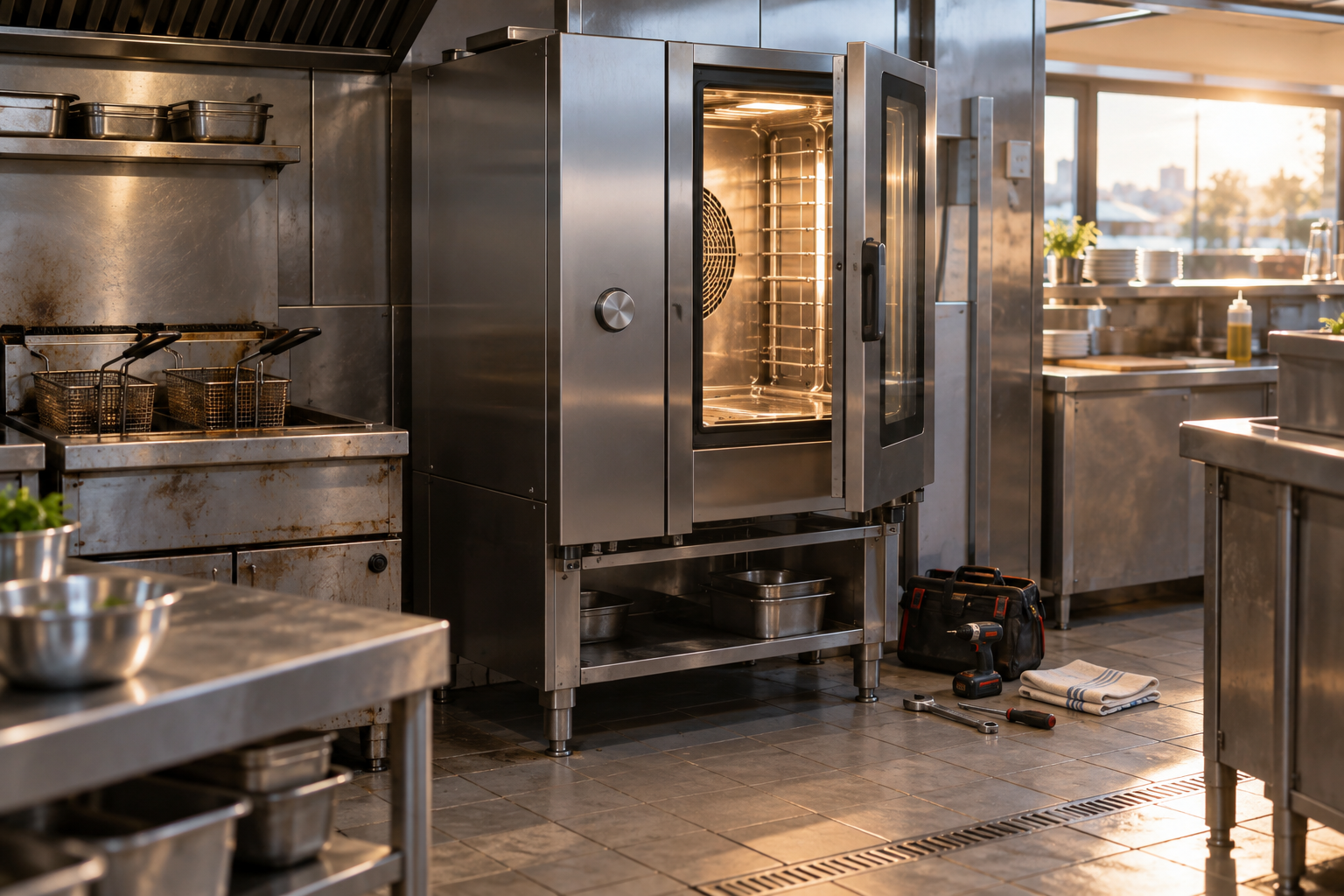
Equipment payback is the contribution a machine has to add before its purchase price comes back to you. A $18,500 combi oven used roughly 300 service days a year over a three-year horizon must add $20.56 of contribution per service day to repay itself in that window. Once the requirement is a daily dollar figure, the question stops being "is it a good oven?" and becomes the only question that matters: can this machine realistically add twenty dollars of contribution a day, every day, for three years?
Start with the payback requirement
The formula is short:
required contribution per service day = purchase price ÷ (service days per year × years in the horizon)
Three inputs, and each one should be conservative:
A $4,200 second fryer used 300 days a year over two years requires $7.00 per service day. Same formula, very different conversation.
- Purchase price: equipment plus installation, delivery, permits, electrical or gas work, and the small items that always appear on the invoice.
- Service days: count the days the equipment will actually run, not every day the restaurant is open. A fryer may run 300 days; a banquet oven may run 120.
- Horizon: the period you expect the machine to be productive before major maintenance. Two to four years is a practical range for many pieces.
Where the contribution actually comes from
Equipment rarely adds contribution by magic. The realistic sources are:
Each one has a dollar value you can estimate from your own data. The trap is counting the same benefit twice — a machine that saves labour hours and adds covers cannot credit both if the extra covers were only possible because of the labour saved.
- Extra covers or batches: additional capacity during peak, which converts turn-aways into sales.
- Labour hours saved: fewer hands needed for the same output, or the same hands handling more.
- Waste reduced: better holding, better reheating, less burning, more consistent batch yields.
- Consumables changed: less oil, fewer disposables, lower energy per cook.
- Consistency: fewer remakes and fewer refunds because the output is repeatable.
- Speed: more throughput per hour in the same footprint.
Worked example A: a combi oven at $18,500
The numbers are illustrative.
Now estimate the offsets honestly:
| Offset | Daily value |
|---|---|
| Labour saved, 0.4 hours at $19.00 | +$7.60 |
| Reduced waste and re-cooks | +$3.10 |
| Energy and consumables delta | −$1.20 |
| Net offset | +$9.50 |
The shortfall is $20.56 − $9.50 = $11.06 per service day. That equals roughly one extra cover a day at $11 of contribution, or about 15 additional banquet portions a week. If the kitchen can demonstrably sell that volume, the machine pays back in the three-year window. If it cannot, the payback stretches and the case rests on consistency alone, which is a legitimate but different argument.
- Purchase and installation: $18,500
- Service days: 300 per year
- Horizon: 3 years (900 service days)
- Required contribution: $20.56 per service day
Worked example B: a second fryer at $4,200
Offsets: one extra batch per service day at $9.20 of contribution, less $1.80 of additional oil and energy use, gives +$7.40 per day. The requirement is met with margin. That is a much easier decision than the combi oven, and the difference is not the price — it is the ratio of daily requirement to realistic daily contribution.
- Purchase and installation: $4,200
- Service days: 300 per year
- Horizon: 2 years (600 service days)
- Required contribution: $7.00 per service day
Buy versus lease, without the financing advice
Leasing converts a capital purchase into a recurring operating cost. For payback purposes, compare the two structures on the same basis:
Leasing lowers the entry cost and can preserve cash, which matters in a tight season. Buying usually wins when the equipment is expected to run well past the financing period and the contribution is stable. Both structures carry terms, fees and tax treatments that belong with your accountant, not in a menu-cost spreadsheet.
- Buy: required daily contribution = purchase price ÷ service days in horizon.
- Lease: required daily contribution = (lease payment + operating delta) ÷ service days in period, and there is no capital recovery at the end.
- Payback in months: purchase price ÷ monthly incremental contribution, using the same offset table.
The decision rule
Write the rule before you look at a catalogue:
Then track it after installation. Record actual daily output, labour hours and waste for the first month and compare with the estimates. Equipment that misses its payback requirement is usually not a bad machine; it is a machine bought for benefits that never materialised, and the tracking is what tells you to change how it is used.
- Go: the realistic daily contribution, from documented offsets, covers the requirement with at least a 20% margin.
- Wait: the requirement is close but one offset is unproven — for example, the extra volume has never been sold. Run a two-week test with borrowed or rented capacity first.
- No: the requirement depends on benefits you cannot measure or on volume you have never achieved.
Limitations and assumptions
- The estimates are estimates. Labour savings only become real dollars if hours are actually removed or redeployed, not just saved on paper.
- Energy and consumable deltas vary widely with usage patterns, utility rates and maintenance. A well-maintained older unit can be cheaper to run than a neglected new one.
- The horizon is a planning assumption, not a guarantee. Major repairs, menu changes and relocation all shorten or extend it.
- This is payback math, not accounting or tax advice. Depreciation, lease terms, financing costs and local incentives are out of scope here.
- Capacity constraints sit outside the formula: if the kitchen cannot physically plate more covers in the peak hour, extra machine capacity does not convert into contribution.
FAQ
What payback period should I aim for?
Two to four years is a practical planning range for most kitchen equipment, with the shorter end for high-use, well-understood items like fryers and the longer end for larger, slower-recovery units. The right horizon is the one you can defend with your own service days and volume.
How do I value labour saved if I do not cut hours?
Value it only if the hours are redeployed to something that earns contribution, or if they reduce overtime. Saved-but-unused hours are a benefit to the team, not a payback source, and counting them makes the decision look better than it is.
Should energy savings be part of the case?
Yes, but as a delta, not an absolute. Compare the new unit's rated and observed usage with what the current equipment actually consumes, and include consumables like oil and cleaning chemicals. A $1.20 daily energy saving is real but rarely large enough to carry a purchase on its own.
What if the equipment is needed for compliance or safety?
Then it is not a payback decision. Regulatory, safety and warranty requirements come first, and the job is to choose the most cost-effective compliant option rather than to justify the purchase with contribution math.
Next step
Run your menu numbers before changing prices. Use the free calculator, then turn the best opportunities into a weekly margin routine.
Open the calculator