Restaurant Finance · 2026-09-21 · 6 min
Delivery Packaging Cost per Order: The Line Most Restaurants Underprice
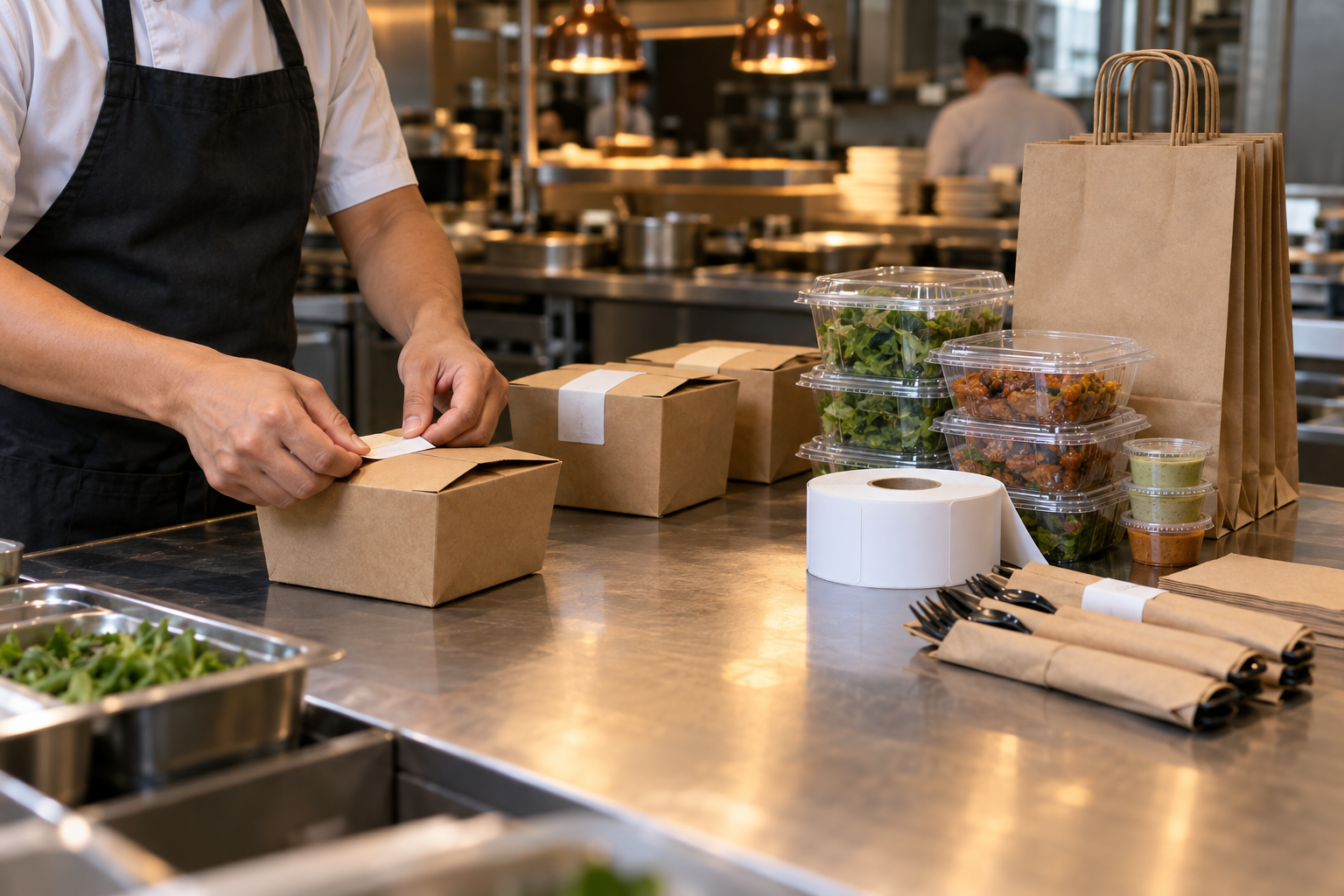
Delivery packaging cost per order is the total value of the containers, lids, bags, labels, cutlery and condiments that leave the building with each delivery order. For a typical entrée-and-side order it is often between $1.00 and $1.60, which is not trivial when commission already takes a quarter to a third of the check. Packaging is a real cost of sale, and it belongs in the delivery contribution calculation beside commission and food cost, not in a general supplies budget where nobody can see it per order.
Why packaging gets missed
Three habits keep packaging invisible:
The consequence is predictable: delivery menus get priced against dine-in contribution and commission, the packaging line is forgotten, and the channel looks better on paper than it is at the bank.
- It is bought in cases, so the per-order cost never appears on an invoice line that anyone associates with a sale.
- It is coded to supplies or "other", so it never shows up next to food cost in a channel margin calculation.
- It is treated as fixed, even though it scales with every delivery order, exactly like food.
Cost one order for real
Pick a normal delivery order, list every single item that leaves the kitchen with it, and price each line from your last invoice per unit.
| Packaging item | Units | Cost per unit | Cost per order |
|---|---|---|---|
| Entrée container with lid | 1 | $0.47 | $0.47 |
| Side container with lid | 1 | $0.25 | $0.25 |
| Kraft carrier bag | 1 | $0.31 | $0.31 |
| Tamper seal / label | 2 | $0.03 | $0.06 |
| Cutlery kit | 1 | $0.11 | $0.11 |
| Napkin | 2 | $0.01 | $0.02 |
| Sauce cups with lids | 2 | $0.07 | $0.14 |
| Total packaging per order | $1.36 |
The numbers are illustrative. The discipline is what matters: unit cost from the invoice, units per order from observation, and a total that a manager can quote from memory. If you do 400 delivery orders a week, that $1.36 is $544 a week, or roughly $28,000 a year, sitting in an unlabeled lane.
Fold packaging into delivery contribution
Now place packaging where it belongs. Take a $27.00 delivery order with $8.60 of food cost and a 30% commission:
Compare that with the same dish sold in-house at $27.00 with $8.60 of food cost and no commission or packaging: the contribution is $18.40 before service labour. Even after the labour a dine-in cover carries, the gap is wide. That does not mean delivery is unprofitable; it means delivery has its own price floor, and packaging is part of it.
- Menu price: $27.00
- Commission: $8.10
- Food cost: $8.60
- Packaging: $1.36
- Contribution before other variable costs: $8.94 (33.1%)
Work out the minimum viable delivery price
If you want the delivery channel to return a target contribution percentage, packaging sets the floor:
minimum price = (food cost + packaging) ÷ (1 − commission % − target contribution %)
With food cost of $8.60, packaging of $1.36, a 30% commission and a 35% contribution target:
($8.60 + $1.36) ÷ (1 − 0.30 − 0.35) = $9.96 ÷ 0.35 = $28.46
So a $27.00 price misses the target by about $1.46. You can close that gap in several ways, and they are not equally painful:
- Price the delivery menu separately rather than applying the same prices as dine-in.
- Change the packaging specification to right-sized containers that cut $0.20–$0.30 per order.
- Bundle a side and drink into a fixed-price combination that raises average check faster than cost.
- Renegotiate or change plans where the platform allows, and check the numbers again after any change.
Cut packaging cost without cutting quality
Packaging cost responds to operations, not just purchasing:
There is also a quality argument for spending more in the right places: a sealed, right-sized container that arrives intact protects the customer relationship that the delivery channel depends on. Cheaper is only cheaper if the order arrives correctly.
- Match container to item. Using an oversized container for a small side wastes cents on every order.
- Standardize sizes. Fewer SKUs mean better case pricing and less line confusion.
- Stop defaulting to cutlery and condiments for orders that do not ask for them; platforms usually expose a toggle.
- Buy by case and store properly. Crushed lids and warped containers become refunds.
- Audit for leakage. A container that fails in transit costs a refund, a remake and a customer, which is far more than the cents saved.
- Review quarterly. Prices, order mix and platform rules change; a packaging cost from last year is a guess.
Limitations and assumptions
- Per-unit packaging prices vary with volume, supplier and specification. Case quantities at a broadline distributor differ from small-format restaurant supply, sometimes by more than 30%.
- Commission rates vary by platform, market, plan and negotiated terms, and some platforms add processing or marketing fees that are not part of the headline rate.
- The example assumes the platform credits nothing back and that no refund or remake occurs. Real channel contribution should include an error-cost line as well.
- Packaging requirements are sometimes set by local rules or platform policy, including rules on reusable and single-use containers, so check what applies in your market before changing specifications.
- Delivery menu pricing is also a demand decision. A price floor tells you what you need; it does not tell you what guests will pay, so test changes rather than assuming volume holds.
FAQ
Should packaging cost go in food cost or overhead?
Put it in food cost for menu and channel calculations, and in a separate supplies account for accounting. Total cost of goods sold for a delivery order includes packaging because the order cannot be sold without it. Keeping a per-order figure visible is what makes the channel decision honest.
What is a normal packaging cost per delivery order?
It depends on the menu. A single entrée in a clamshell is often under $0.80; a multi-item order with bags, sides, sauces and cutlery can exceed $1.50. The only number that matters is yours, measured from a real invoice and a real order.
How often should I re-cost packaging?
Quarterly, and any time you change a container, a supplier or a platform plan. Packaging prices move less often than food prices, but the order mix changes constantly, so the cost per order drifts even when unit costs are stable.
Does packaging cost apply to takeout as well as delivery?
Yes, and it is often overlooked there because there is no commission to remind anyone the order is different. Takeout packaging is cheaper than commission, but it is still a variable cost that deserves a line in the channel contribution calculation.
Next step
Run your menu numbers before changing prices. Use the free calculator, then turn the best opportunities into a weekly margin routine.
Open the calculator