Food Cost · 2026-07-19 · 8 min
Theoretical vs Actual Food Cost: Find the Restaurant Variance
Theoretical food cost is what your restaurant should have used based on recipes and recorded sales. Actual food cost is what inventory and purchasing records show you used. The difference between them is the variance. Comparing the two each week helps managers find waste, portion inconsistency, unrecorded comps, transfer errors, sales-mix changes, and recipe-costing problems before they quietly reduce profit.
What Is Theoretical Food Cost?
Theoretical food cost represents the ingredient cost your restaurant should incur for the food it sold. It starts with standardized recipes, ingredient costs, and the number of portions or menu items sold during a period.
For each item, multiply the quantity sold by its recipe cost. Add those item-level costs together, then divide by food sales to express theoretical food cost as a percentage. A reliable recipe database is essential because inaccurate portions, yields, or ingredient prices will make the theoretical number misleading.
- Recipe cost should reflect usable yield, trim, cooking loss, and the actual portion served.
- Update ingredient prices when vendor invoices change materially.
- Separate food sales from beverage, tax, delivery fees, and other non-food revenue when calculating the percentage.
What Is Actual Food Cost?
Actual food cost measures the food value that left inventory during the period. The basic calculation is beginning inventory plus purchases minus ending inventory. Divide the result by food sales to calculate actual food cost percentage.
For a clear explanation of the calculation, see the RestaurantMargin food cost formula. The calculation is only useful when inventory counts are consistent, invoices are entered in the correct period, and transfers or credits are recorded accurately.
- Count the same storage areas, units, and products every week.
- Record supplier credits, returns, spoilage, and donations with supporting notes.
- Keep purchase timing consistent so one week does not absorb invoices from another period.
The Theoretical vs Actual Food Cost Variance
The variance is the difference between actual food cost and theoretical food cost. If actual food cost is higher, the restaurant used or lost more product than its recipes and sales records explain. If actual food cost is lower, check for delayed invoices, incomplete counts, unusual purchasing timing, or recipe data that overstates usage.
You can express the variance in percentage points or dollars. A useful dollar view is actual food usage minus theoretical food usage. Converting the gap into dollars helps managers prioritize the issues that can meaningfully affect restaurant margin.
- Theoretical food cost percentage = theoretical food usage divided by food sales.
- Actual food cost percentage = actual food usage divided by food sales.
- Variance percentage points = actual food cost percentage minus theoretical food cost percentage.
- Variance dollars = actual food usage minus theoretical food usage.
Worked example — week ending August 16, 2026 [illustrative]
Same currency throughout (USD). Food sales exclude beverage, tax, delivery fees. This is an illustrative example, not operator records.
Theoretical usage from recipes x portions sold: $3,360. Theoretical % = 3,360 / 12,000 = 28.0%.
Actual usage: Beginning $2,500 + Purchases $3,800 - Ending $2,340 = $3,960. Actual % = 3,960 / 12,000 = 33.0%.
Variance = 33.0 - 28.0 = 5.0 percentage points. Variance = 3,960 - 3,360 = $600 for the week. For the base calculation see the RestaurantMargin food cost formula.
Build a Weekly Variance Bridge
Start with $3,360 theoretical, add explainable categories to reach $3,960 actual. Keep one owner per line.
| Bridge line | $ | Check this week |
|---|---|---|
| Theoretical usage | 3,360 | sum sold x recipe cost |
| Prep waste + spoilage logged | +180 | trim, over-prep, expired |
| Portion / yield vs standard | +150 | scoop, ladle, scale check |
| Unrecorded comps / staff meals | +120 | tie POS comp to usage |
| Transfers / count cutoff | +90 | station, storage, late receipt |
| Invoice credits / timing | +60 | returns, pack-size change |
| Actual usage | 3,960 | begin + purchases - end |
| Variance for action | $600 / 5.0pp | fix largest $ first |
Figure: weekly variance bridge from $3,360 theoretical to $3,960 actual — illustrative week ending August 16, 2026.
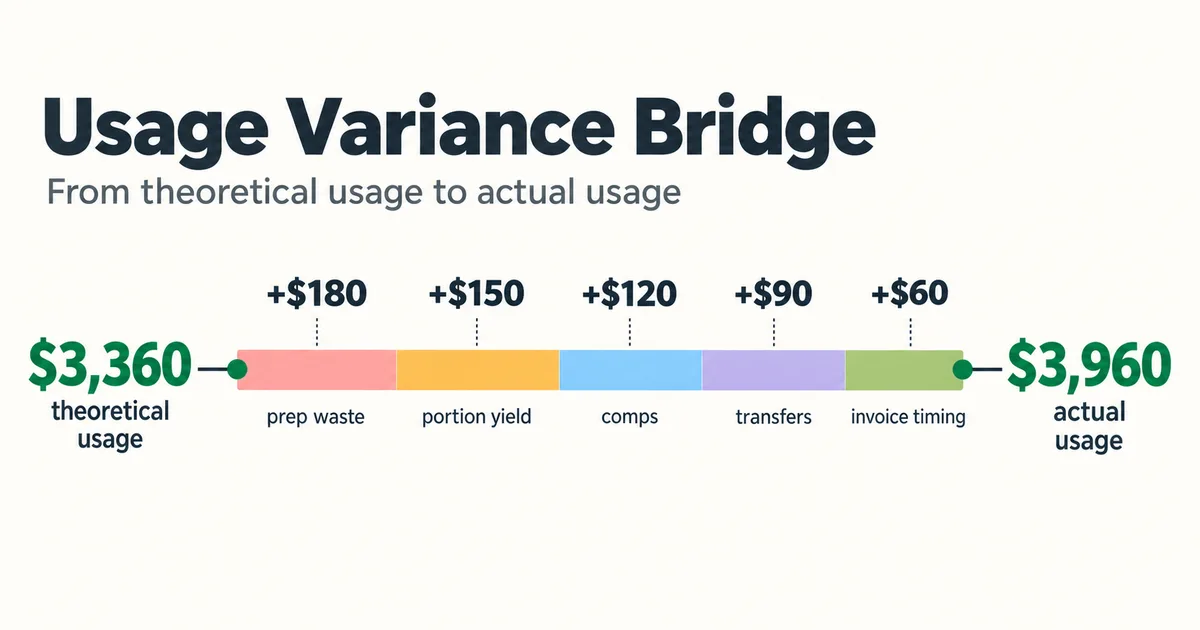
Review the bridge alongside purchasing, inventory counts, sales mix, and production records. The goal is not to create a perfect accounting explanation for every cent. The goal is to identify repeatable patterns and determine which controls deserve attention this week.
- Recipe and portion variance: Compare actual portions, scoops, ladles, and prep yields with standards.
- Waste and spoilage: Separate prep waste, expired product, production errors, and damaged goods.
- Comps and staff meals: Confirm that free or discounted items are recorded and tied to inventory usage.
- Transfers: Reconcile products moved between locations, stations, or storage areas.
- Purchasing and invoice timing: Check credits, substitutions, pack sizes, and invoices posted in the wrong period.
- Sales mix: Look for a higher share of dishes that use expensive ingredients or a lower share of high-margin items.
Common Causes of Food-Cost Drift
A variance is a signal, not a diagnosis. Managers should avoid assuming that theft or poor performance is the cause before checking the records and workflow. Several small inconsistencies can create a meaningful gap between theoretical and actual food cost.
Start with the categories that are easiest to verify. A missing transfer, incorrect unit conversion, or recipe with an outdated vendor price can create an apparent operating problem even when the kitchen is following its process.
- Portion sizes exceed the recipe standard or vary by shift.
- Recipes omit garnishes, sauces, oils, or sides that are used in production.
- Yield assumptions do not match the product after trimming or cooking.
- Waste is discarded without being logged or categorized.
- Comps, voids, staff meals, and catering samples are not connected to usage.
- Inventory is counted in inconsistent units, such as cases one week and individual pieces the next.
- Products are received, transferred, or credited after the count cutoff.
Turn the Review Into Operator Actions
The best variance review ends with a short action list, an owner, and a date for checking the result. Avoid responding to a broad percentage with broad instructions such as “control portions.” Instead, identify the ingredient, menu item, shift, or process most likely to explain the gap.
Use a plate cost calculator to validate recipe economics when portions or ingredient prices change. Then review menu pricing and contribution margin before making changes to a popular item. If the variance points to recurring waste or over-portioning, use the RestaurantMargin reduce food cost guidance to choose a practical control.
Recheck the same bridge next week; if the same $120+ category repeats, fix that process before chasing smaller lines. Validate recipe changes with the plate-cost calculator and choose controls from reduce food cost.
- Choose the largest explainable variance category first.
- Assign one manager to verify the process during the next service period.
- Retrain with a visual portion standard, scale, scoop, or labeled prep container.
- Recount only the affected items when a full recount is unnecessary.
- Track whether the same category improves in the next weekly review.
- Use the free RestaurantMargin calculators for food-cost and margin checks, then explore the paid restaurant margin playbooks for deeper operating systems and decision guides.
FAQ
What is the difference between theoretical and actual food cost in a restaurant?
Theoretical food cost is the ingredient cost expected from recipes and recorded sales. Actual food cost is the ingredient usage shown by beginning inventory, purchases, and ending inventory. Their difference is the food-cost variance.
What does a high actual food cost compared with theoretical food cost mean?
It means recorded inventory usage is higher than the usage explained by recipes and sales. Possible causes include waste, over-portioning, unrecorded comps, incorrect yields, transfer errors, invoice timing, or inventory-count mistakes.
How often should a restaurant compare theoretical and actual food cost?
Most operators benefit from a weekly comparison because it provides timely feedback without creating excessive administrative work. Monthly reviews can support financial reporting, but they may delay corrective action.
Can sales mix create a variance between theoretical and actual food cost?
Sales mix can affect the expected cost percentage when the calculation uses incomplete or inaccurate recipe and sales data. A properly calculated theoretical cost already reflects the items sold, so an unexplained gap after accounting for sales mix points to another issue.
What information is needed to calculate actual food cost?
You need beginning inventory, food purchases, ending inventory, and food sales for the same period. Consistent counting procedures and accurate invoice, credit, return, and transfer records are also important.
Next step
Run your menu numbers before changing prices. Use the free calculator, then turn the best opportunities into a weekly margin routine.
Open the calculator